
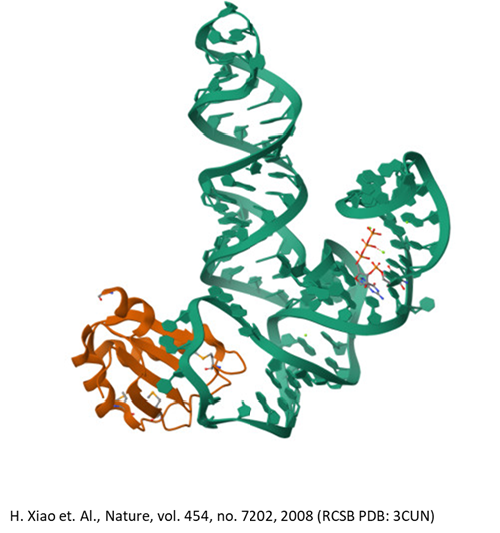
minimal tRNA acceptor-stem mimic for flexizyme acylation
Microhelix is a 22-nucleotide RNA that mimics the acceptor stem of a transfer RNA in miniature: a 7-base-pair helix closed by a stable UUCG tetraloop, followed by a discriminator base and the 3′-terminal CCA. Flexizymes recognize only the conserved 3′-CCA region and do not read the body of the tRNA, so a microhelix is charged essentially as efficiently as full-length tRNA despite lacking the anticodon arm, D-arm and T-arm; Katoh and Suga reported closely comparable acylation yields for microhelix and full-length tRNA under identical conditions. It is therefore the standard substrate for assaying flexizyme activity and optimizing acylation conditions, and works with both eFx and dFx. Its small size is a practical advantage: aminoacylation can be read out directly by acid-denaturing PAGE or MALDI-TOF mass spectrometry, without the RNase digestion step that full-length tRNA requires to bring the analyte into a usable mass range. Minihelix and microhelix substrates of this type were also central to establishing that aminoacyl-tRNA synthetase specificity can reside in the acceptor stem alone — the “operational RNA code” for amino acids.
Applications:
1) Francklyn, C., & Schimmel, P. (1989). Aminoacylation of RNA minihelices with alanine. Nature, 337(6206), 478–481
2) Schimmel, P., Giege, R., Moras, D., & Yokoyama, S. (1993). An operational RNA code for amino acids and possible relationship to genetic code. Proceedings of the National Academy of Sciences, 90(19), 8763-8768
3) Murakami, H., Ohta, A., Ashigai, H., & Suga, H. (2006). A highly flexible tRNA acylation method for non-natural polypeptide synthesis. Nature Methods, 3(5), 357-359
4) Xiao, H., Murakami, H., Suga, H., & Ferré-D’Amaré, A.R. (2008). Structural basis of specific tRNA aminoacylation by a small in vitro selected ribozyme. Nature, 454(7202), 358-361
5) Goto, Y., Katoh, T., & Suga, H. (2011). Flexizymes for genetic code reprogramming. Nature Protocols, 6(6), 779-790
6) Katoh, T., & Suga, H. (2019). Flexizyme-catalyzed synthesis of 3’-aminoacyl-NH-tRNAs. Nucleic Acids Research, 47(9), e54
Cisterna's off-the-shelf RNAs are validated and ready to order through our quick quote system. Simply follow these steps: Step 1 (Find your RNA) If you already know what you need, select your desired RNA directly from the main page. If you'd like to learn more first, browse by category, click on the RNA name to view its product page, and explore usage examples and references before ordering. Step 2 (Add to Cart) Choose your preferred 'Quality', 'Amount', and 'Quantity', then click 'Add to Cart'. Repeat for any additional items. Step 3 (Get a Quote) When all items are in your cart, click 'Get a Quote'. Fill in your name, professional email, and academic or business address. Please note that personal email addresses and home addresses will not be accepted. Step 4 (Save your Quote) Once your information is complete, you can download your quote as a PDF for your records. Step 5 (Checkout) Click 'Continue to Checkout' to proceed to the final order page. If your institution requires it, you can enter an optional Purchase Order (PO) number here. Review your order and click 'Place an Order'. That's it! We'll take it from here. Your RNA will be synthesized and shipped as quickly as possible. Invoices are sent electronically upon confirmation of delivery, and all invoices are issued on Net30 terms.
PRIME is Cisterna's core RNA production platform, capable of synthesizing all RNA types including mRNA, tRNA, siRNA, sgRNA, aptamers, and more. The PRIME platform is engineered to drastically reduce product-related impurities such as dsRNA, short-truncated products, abortive transcripts, and DNA:RNA hybrids, all commonly generated in standard in vitro transcription. The result is consistently high-quality RNAs that are fully functional and well-suited for most downstream applications such as X-ray crystallography, Cryo-EM, tRNA aminoacylation and protein expression.
Both PRIME and SPECC reflect Cisterna’s commitment to producing high-quality RNA, but they are designed to serve different needs. PRIME is Cisterna’s standard production platform and is applicable to all RNA types. It delivers high-purity RNA suitable for a wide range of applications, from structural and biochemical studies to robust protein expression. For most research applications, PRIME offers excellent performance and exceptional value at an affordable price point. SPECC (SPEcific Capture and Cleavage) is Cisterna’s flagship purification system and is currently available for mRNA only. It takes purity a step further by selectively isolating full-length mRNA transcripts, enabling near-HPLC-level purity. SPECC is the ideal choice when the highest possible mRNA quality is desired, such as in rigorous quantitative studies, high-dose applications, or therapeutic development.