
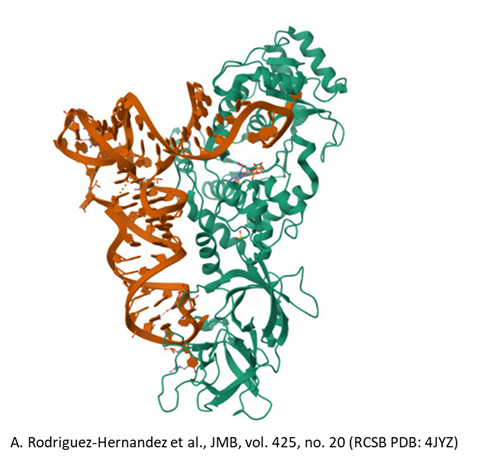
E. coli tRNA coding for glutamine TTG anti-codon
E. coli tRNA1(Gln) (TTG anticodon) is one of two isoacceptor tRNAs responsible for delivering glutamine to the ribosome, decoding both CAA and CAG glutamine codons during translation. The wobble position U34 of this tRNA carries the hypermodified nucleoside 5-carboxyaminomethyl-2-thiouridine (cmnm⁵s²U) in its native form; mass spectrometric analysis of affinity-purified native tRNA1(Gln) confirmed this as the complete modification. The 2-thio moiety alone improves binding affinity to glutaminyl-tRNA synthetase (GlnRS) by 10-fold over an unmodified transcript, with the cmnm⁵ modification contributing a further 4-fold improvement. While the listed tRNA does not possess these modifications, it serves as a useful control tRNA for structure-function studies. GlnRS is a Class I aminoacyl-tRNA synthetase that recognizes tRNA(Gln) through contacts spanning the entire inside of the L-shaped molecule, from the anticodon to the acceptor stem. The primary identity elements are all three anticodon bases and key acceptor stem positions, including the discriminator base G73 and the G1·U72 pair; contacts with the 2-amino groups of G2 and G3 via the minor groove further contribute to discrimination. Upon binding GlnRS, the anticodon loop undergoes a major conformational rearrangement in which the anticodon stem is extended by two non-Watson-Crick base pairs, leaving the three anticodon bases fully unpaired and splayed into three separate complementary pockets on the enzyme surface, a binding mode that provides the structural basis for synthetase discrimination among tRNA species. Across species, U34 has been identified as the dominant single identity element governing recognition by related glutamyl-tRNA synthetases.
Applications:
1) RNAcentral ID: URS000059276A_511145
2) Rould, M.A., Perona, J.J. & Steitz, T.A. (1991). Structural basis of anticodon loop recognition by glutaminyl-tRNA synthetase. Nature 352(6332):213–218
3) Rogers, K.C. & Söll, D. (1993). Discrimination among tRNAs intermediate in glutamate and glutamine acceptor identity. Biochemistry 32(51):14210–14219
4) Rogers, M.J., Weygand-Durasević, I., Schwob, E., Sherman, J.M., Rogers, K.C., Adachi, T., Inokuchi, H. & Söll, D. (1993). Selectivity and specificity in the recognition of tRNA by E. coli glutaminyl-tRNA synthetase. Biochimie 75(12):1083–1090
5) Kim, S.I. & Söll, D. (1998). Major identity element of glutamine tRNAs from Bacillus subtilis and Escherichia coli in the reaction with B. subtilis glutamyl-tRNA synthetase. Mol. Cells 8(4):459–465
6) Rodriguez-Hernandez, A., Spears, J.L., Gaston, K.W., Limbach, P.A., Gamper, H., Hou, Y.-M., Kaiser, R., Agris, P.F. & Perona, J.J. (2013). Structural and mechanistic basis for enhanced translational efficiency by 2-thiouridine at the tRNA anticodon wobble position. J. Mol. Biol. 425(20):3888–3906 RCSB PDB: 4JYZ
Cisterna's off-the-shelf RNAs are validated and ready to order through our quick quote system. Simply follow these steps: Step 1 (Find your RNA) If you already know what you need, select your desired RNA directly from the main page. If you'd like to learn more first, browse by category, click on the RNA name to view its product page, and explore usage examples and references before ordering. Step 2 (Add to Cart) Choose your preferred 'Quality', 'Amount', and 'Quantity', then click 'Add to Cart'. Repeat for any additional items. Step 3 (Get a Quote) When all items are in your cart, click 'Get a Quote'. Fill in your name, professional email, and academic or business address. Please note that personal email addresses and home addresses will not be accepted. Step 4 (Save your Quote) Once your information is complete, you can download your quote as a PDF for your records. Step 5 (Checkout) Click 'Continue to Checkout' to proceed to the final order page. If your institution requires it, you can enter an optional Purchase Order (PO) number here. Review your order and click 'Place an Order'. That's it! We'll take it from here. Your RNA will be synthesized and shipped as quickly as possible. Invoices are sent electronically upon confirmation of delivery, and all invoices are issued on Net30 terms.
PRIME is Cisterna's core RNA production platform, capable of synthesizing all RNA types including mRNA, tRNA, siRNA, sgRNA, aptamers, and more. The PRIME platform is engineered to drastically reduce product-related impurities such as dsRNA, short-truncated products, abortive transcripts, and DNA:RNA hybrids, all commonly generated in standard in vitro transcription. The result is consistently high-quality RNAs that are fully functional and well-suited for most downstream applications such as X-ray crystallography, Cryo-EM, tRNA aminoacylation and protein expression.
Both PRIME and SPECC reflect Cisterna’s commitment to producing high-quality RNA, but they are designed to serve different needs. PRIME is Cisterna’s standard production platform and is applicable to all RNA types. It delivers high-purity RNA suitable for a wide range of applications, from structural and biochemical studies to robust protein expression. For most research applications, PRIME offers excellent performance and exceptional value at an affordable price point. SPECC (SPEcific Capture and Cleavage) is Cisterna’s flagship purification system and is currently available for mRNA only. It takes purity a step further by selectively isolating full-length mRNA transcripts, enabling near-HPLC-level purity. SPECC is the ideal choice when the highest possible mRNA quality is desired, such as in rigorous quantitative studies, high-dose applications, or therapeutic development.